

Polarization Over Coffee
In a world where troubling news abounds, Tysons Interfaith is dedicating 2026 to highlighting “What’s Going Right.” Whether it is individuals, organizations or nations working to improve the lives of others and to build a just and peaceful future for all of us, there is always good news to be found.
The following blog post illustrates how people of differing faiths and backgrounds are gathering in community to have meaningful conversations. Please join us! We hope this post will encourage and inspire you to make a positive difference in your own corner of the world.
————————————————————————————————-
Contributed by Stephen Wickman, St. Thomas Episcopal
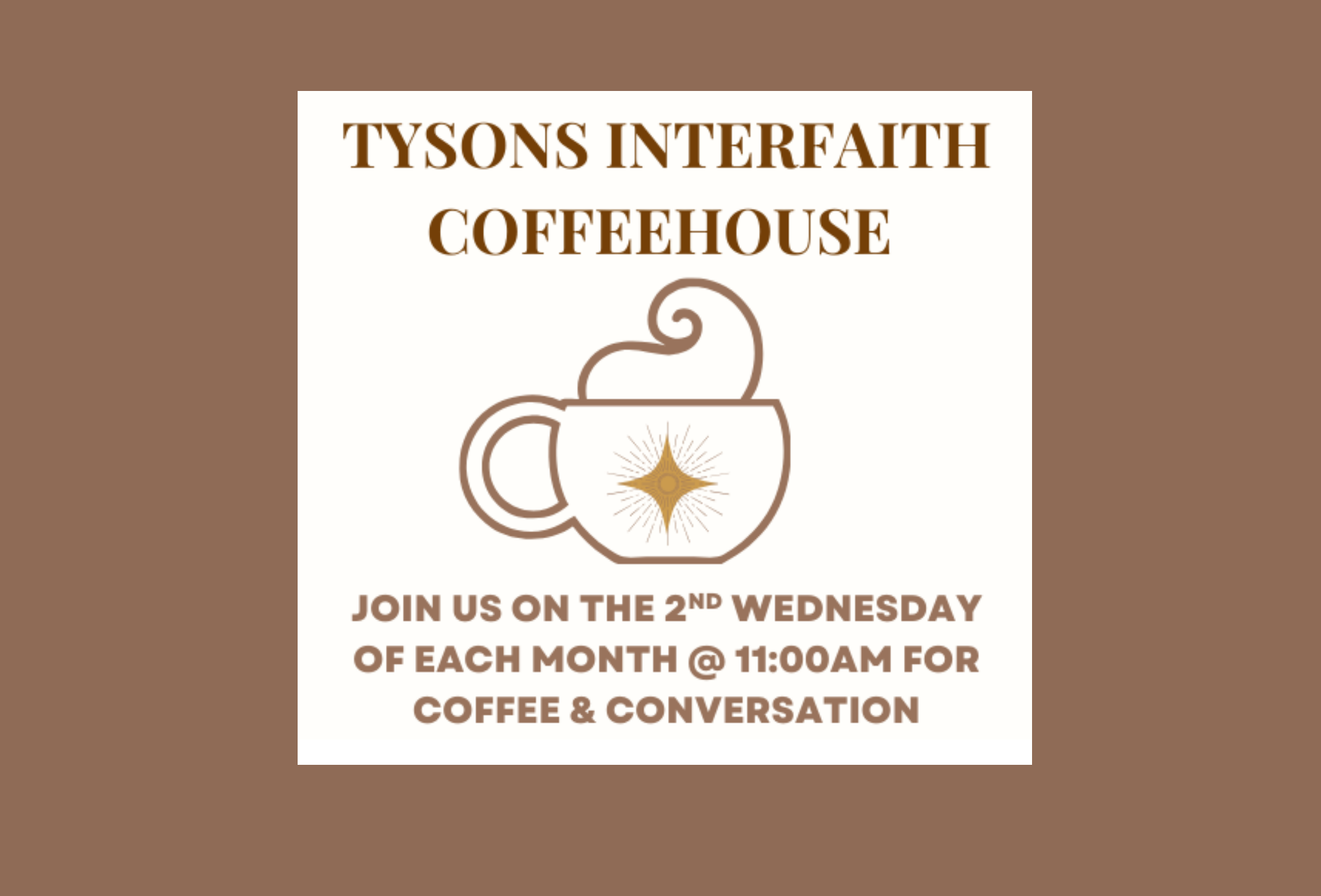
The theme of this month’s Tysons Interfaith Coffee House was polarization, a major concern that came up in prior months. (Please drop by anytime 11:00-12:30 on the second Wednesday each month; programs start about 11:30, but all are welcome at any time.)
Facilitated by the Rev. Dr. Trish Hall, we talked about how our personal blinders go up when we discuss sensitive subjects and how we interrupt and focus on ourselves. To avoid this, it was important to listen respectfully, even to those who cannot seem to articulate the foundation for their beliefs or who lack critical reasoning skills.
I was put on the spot at one point to explain why I am a Christian, and my response was all over the map. I noted that my faith journey began in the fundamentalism of my family, moved through the Methodist church, and then found a home in the broad tent of the American Episcopal church. In retrospect, I was trying to explain what some call the Wesleyan Quadrilateral, after John Wesley, the Anglican priest who founded Methodism and who based his teaching on scripture, tradition, reason, and experience. The Episcopal Church accepts his approach, among many others.
I was also asked why, as a Christian, I am moved to participate in interfaith work. Well, Jesus of Nazareth expressed his love for all people, particularly those on the margins of society, regardless of their background. Shortly after his death, Paul the Evangelist successfully promoted his teaching, linking it to Judaism and Greek traditions and philosophy. These had broad appeal that ultimately enlightened Europe and America.
Foreign observers have long noted that, more so than in Europe, religion is a powerful force in American society. This fact puzzled Alexis de Tocqueville, who esteemed the United States for keeping religion out of politics and relegating it to the personal sphere. Perhaps that has changed, particularly with the rise of social media, where personal opinions are blared far and wide in the form of memes or short posts that often lack civility, let alone critical thinking.
I will leave you with something I came across recently on a Jesuit website. I hope it will spark your interest to join our discussions.
A Prayer for Unity
In this century and in any century,
Our deepest hope, our most tender prayer,
Is that we learn to listen.
May we listen to one another in openness and mercy
May we listen to plants and animals in wonder and respect
May we listen to our own hearts in love and forgiveness
May we listen to God in quietness and awe.
And in this listening,
Which is boundless in its beauty,
May we find the wisdom to cooperate
With a healing spirit, a divine spirit
Who beckons us into peace and community and creativity.
We do not ask for a perfect world.
But we do ask for a better world.
We ask for deep listening.
– Jay McDaniel, Professor of Religion, Hendrix College, Arkansas
This blog post is the expressed opinion of its writer and does not necessarily reflect the views of Tysons Interfaith or its members.
To learn more about Tysons Interfaith, please visit: https://tysonsinterfaith.org/.

Copyright 2026 © TYSONS INTERFAITH. All rights reserved.