


Contributed by Lois Herr — First Church of Christ, Scientist, McLean
Many people set aside time in their day for prayer, reflection, or meditation. As a Christian Science practitioner, I often find inspiration in daily audio reflections presented by members of our church, called the Daily Lift.
A recent Daily Lift by Madora Kibbe, a Christian Scientist Practitioner and teacher from New York, New York, is entitled, “Why Would You Love An Enemy?” In this segment, Madora notes that the Sermon on the Mount (the manifesto for peace) in the Christian Bible directs that we love our enemies – “and that is hard!” To illustrate her point, Madora shares a touching vignette about her father, who served in World War II. She concludes that because we are all manifestations of the spirit of our creator, it is our duty to separate wrongdoing from people. For Madora, loving our enemy, is indeed, the only real answer.
The Daily Lift is comprised of audio presentations contributed by Christian Science church members worldwide – with the majority coming from the U.S. This particular Lift will remain on the website for thirty days before being retired.
May this segment bring you peace and encouragement.
This blog post is the expressed opinion of its writer and does not necessarily reflect the views of Tysons Interfaith or its members.
Contributed by Stephen Wickman: St. Thomas Episcopal, McLean
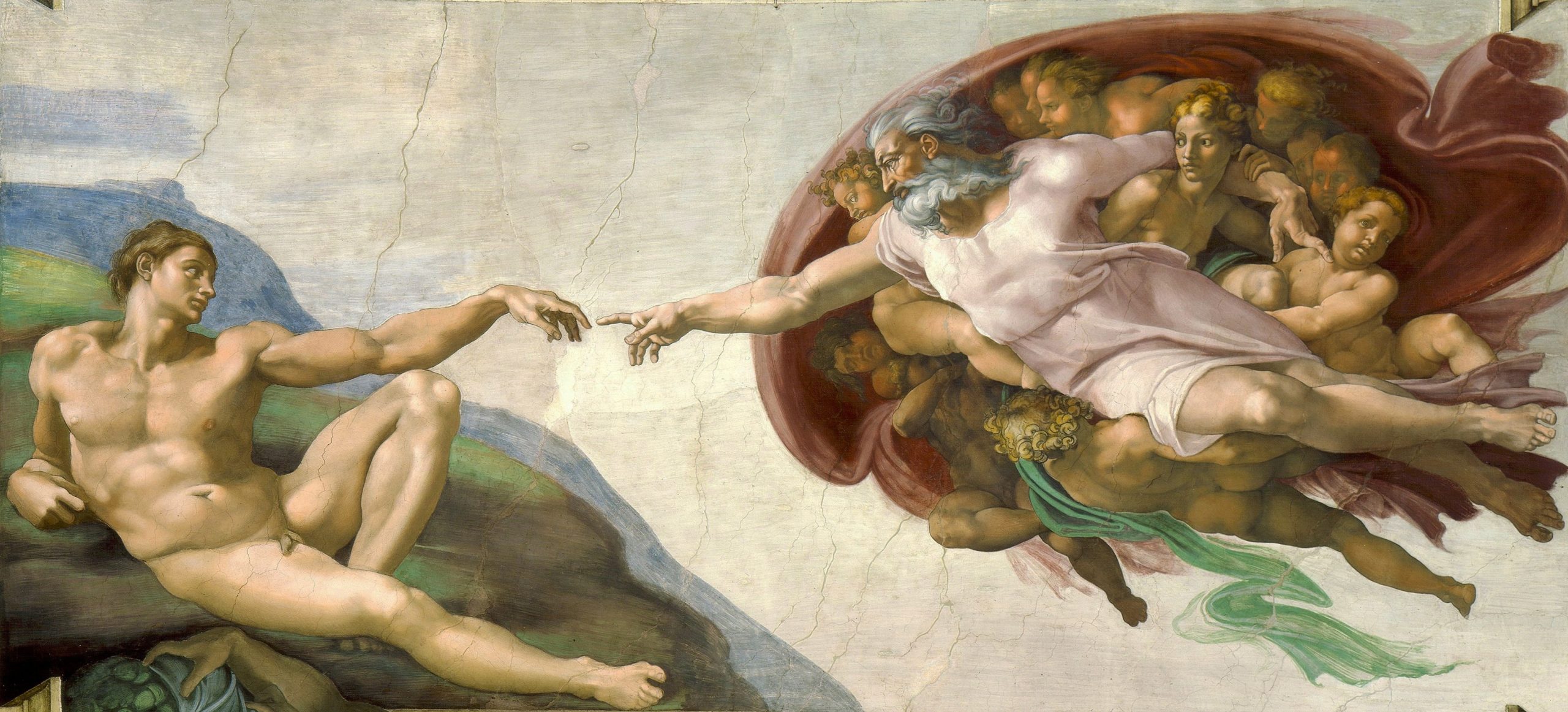
“What would they do if they were tested with a great tragedy, wouldn’t they need God for comfort?”
That was the question asked by one of our Baha’i friends at last week’s Interfaith Coffee House (please come!) in response to my snarky suggestion that, looking at the lives of my son and his wife and daughter at least, one doesn’t have to believe in God or practice a particular faith to lead a good and contented life. It got me thinking.
It’s not always the need for comfort that brings us to God, although there’s a long strain in Christianity that sees this. In fact, listening to a BBC broadcast about prison conversions the other day, I was struck by how these events occur most often when a person is at their lowest ebb.
But then there is the case of Saul on the road to Damascus: the man who became Paul knew in his heart that persecution was not God’s will. Justice, humanity, and love for one’s enemies – not comfort – was the basis for his conversion. Of course, when Paul was imprisoned in what is now Turkey, he led his fellow prisoners in hymns to God even as they experienced a massive earthquake. He told them to take comfort in the Lord and not to escape and ended up converting their jailor!
If you examine the life of Christ or Buddha or perhaps of other religious leaders, “comfort” is not the first word that comes to mind. They struggled often, and almost as frequently they called us to live a life of discomfort. As Jesus put it in Matthew 10:
‘Do not think that I have come to bring peace to the earth; I have not come to bring peace, but a sword.
For I have come to set a man against his father,
and a daughter against her mother,
and a daughter-in-law against her mother-in-law;
and one’s foes will be members of one’s own household.
Whoever loves father or mother more than me is not worthy of me; and whoever loves son or daughter more than me is not worthy of me; and whoever does not take up the cross and follow me is not worthy of me. Those who find their life will lose it, and those who lose their life for my sake will find it.’
Not exactly a message of comfort.
But I’m sure our Baha’i colleague had something else in mind when he used the word “comfort.” In the face of adversity, one can indeed take comfort in the assurance that God is with you and that someday soon this will be overcome. That’s what motivated Paul in captivity, and that’s what has helped so many in the world overcome injustice.
This blog post is the expressed opinion of its writer and does not necessarily reflect the views of Tysons Interfaith or its members.

Contributed by Stephen Wickman, St. Thomas Episcopal, McLean
“Why Have Empathy for Those Who Never Extend It?” is how Qasim Rashid begins a brave essay that reflects on the death of Charlie Kirk Reflections on the Death of Charlie Kirk. It is well worth the time to read his thoughts in full, but here is a summary:
Rashid argues that Kirk rarely extended empathy and often poured contempt on many groups of Americans, including Muslims, engendering hatred.
And he returns to a verse from the Qur’an for guidance:
“O ye who believe! be steadfast in the cause of God, bearing witness in equity; and let not a people’s enmity incite you to act otherwise than with justice. Be always just, that is nearer to righteousness. And fear God. Surely, God is aware of what you do.” — Chapter 5, Verse 9
Rashid detests and works ferociously to counter what he views as the hatred that Kirk engendered but at the same time does not allow these injustices to make him retaliate in kind. As he puts it: “I will not allow his fear of the other infect my ability to see the humanity in every person.”
And here is an important comment from the niece of Rev. Martin Luther King:
‘And now while his family and this nation grieve, some are calling him a racist. A white supremacist. Even a fake Christian. Such accusations are conversations unbecoming to a Christian,” she continued. “In the final analysis, Charlie stood for life, for faith, and biblical truth. He wasn’t afraid to say the name of Jesus in the public square, and he paid a price for it. Now is not the time to attack Charlie. It’s the time to lift up the banner of Christ as the member of the one blood human race Charlie Kirk did. His legacy of public discourse of bringing difficult conversations to the table mattered. He caused us to think and to pray. Charlie has gone to meet his maker. May he rest in peace. May we honor him today by praying for his family and by answering this question: Where will you spend eternity?’
“Such empathy or hard “love” is a basic premise of all our faith traditions. I disagree with Kirk on most things, but especially on his treatment of the LGBTQ community, Muslims and “progressives,” but like Rashid’s, my faith requires me to respond with kindness even as I express my disagreement.
In the Book of Common Prayer of the Episcopal Church, there is a prayer for one’s “enemies” that carefully balances responsibility on both sides of a conflict:
“O God, the Father of all, whose Son commanded us to love
our enemies: Lead them and us from prejudice to truth:
deliver them and us from hatred, cruelty, and revenge; and in
your good time enable us all to stand reconciled before you,
through Jesus Christ our Lord. Amen.”
In that spirit and in the spirit of Islam and other faith traditions, let us extend our empathy and love, without prejudice, to the Kirk family and his supporters.
This blog post is the expressed opinion of its writer and does not necessarily reflect the views of Tysons Interfaith or its members.
Contributed by Susan Posey, Redeemer Lutheran Church, McLean
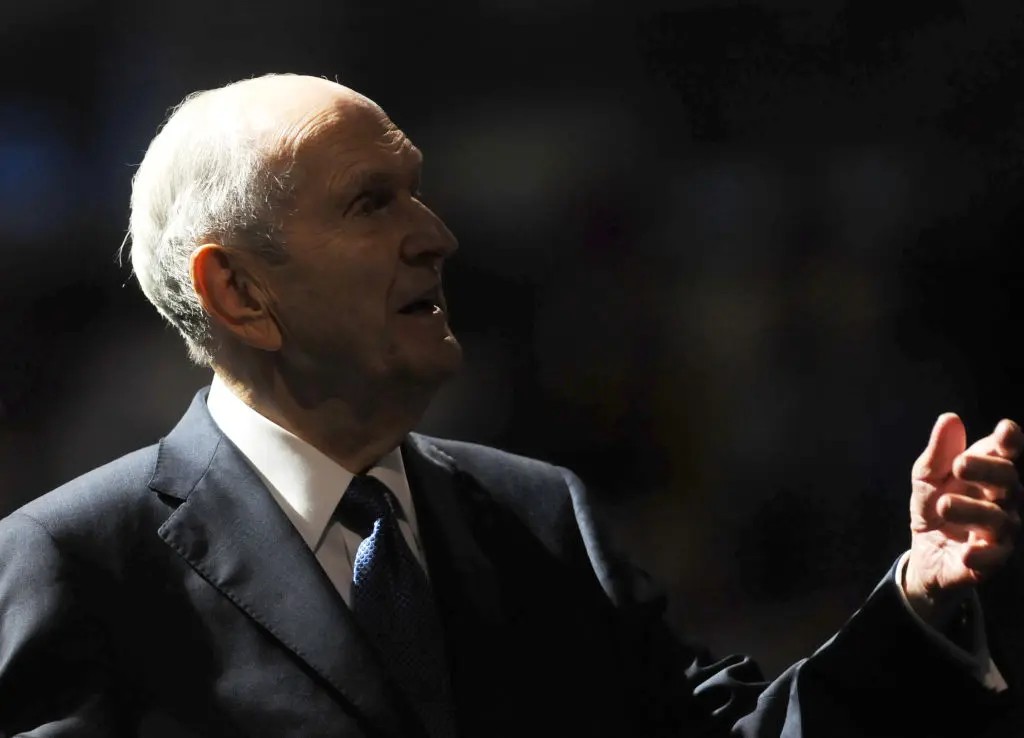
A friend of mine recently shared a link to an article published in Time entitled, We All Deserve Dignity and Respect. It is authored by Russell Nelson, the President of The Church of Jesus Christ of Latter-Day Saints on the occasion of his 101st birthday! Mr. Nelson’s observations are his gift to us, and I for one, found them to be very encouraging.
Here are a few snippets:
“The world has changed dramatically. Yet what I have learned is that some truths do not change. These enduring truths are what anchor us in turbulent times.”
On the occasion of my 101st birthday, I wish to share two such truths – lessons that I believe contribute to lasting happiness and peace.
First: Each of us has inherent worth and dignity. I believe we are all children of a loving Heavenly Father. But no matter your religion or spirituality, recognizing the underlying truth beneath this belief that we all deserve dignity is liberating – it brings emotional, mental, and spiritual equilibrium – and the more you embrace it, the more your anxiety and fear about the future will decrease.
Second: Love your neighbor and treat them with compassion and respect. A century of experience has taught me this certainty: anger never persuades, hostility never heals, and contention never leads to lasting solutions.”
Regardless of your religious or spiritual practice, I think there is much wonderful food for thought in this article, the full text of which can be found here.
Happy Birthday, Mr. Nelson, and thank you for sharing your wisdom with us.
This blog post is the expressed opinion of its writer and does not necessarily reflect the views of Tysons Interfaith or its members.
This past summer at McLean Baptist Church we did a series of Sunday morning group studies titled ‘Kaleidoscope of Faith.’ I had the pleasure of presenting the last session of the series and the topic I chose was Faith & Gratitude. Some of the other sessions included Faith & Travel, Faith & Science, Faith & Storytelling and even Faith & Spies.
I began by giving this specific definition of what I mean by gratitude – the feeling you experience when you acknowledge having something that’s valuable to you and that came to you as a gift. Whatever it is, you did not get it through any kind of transaction and it’s not anything that you feel is owed to you.
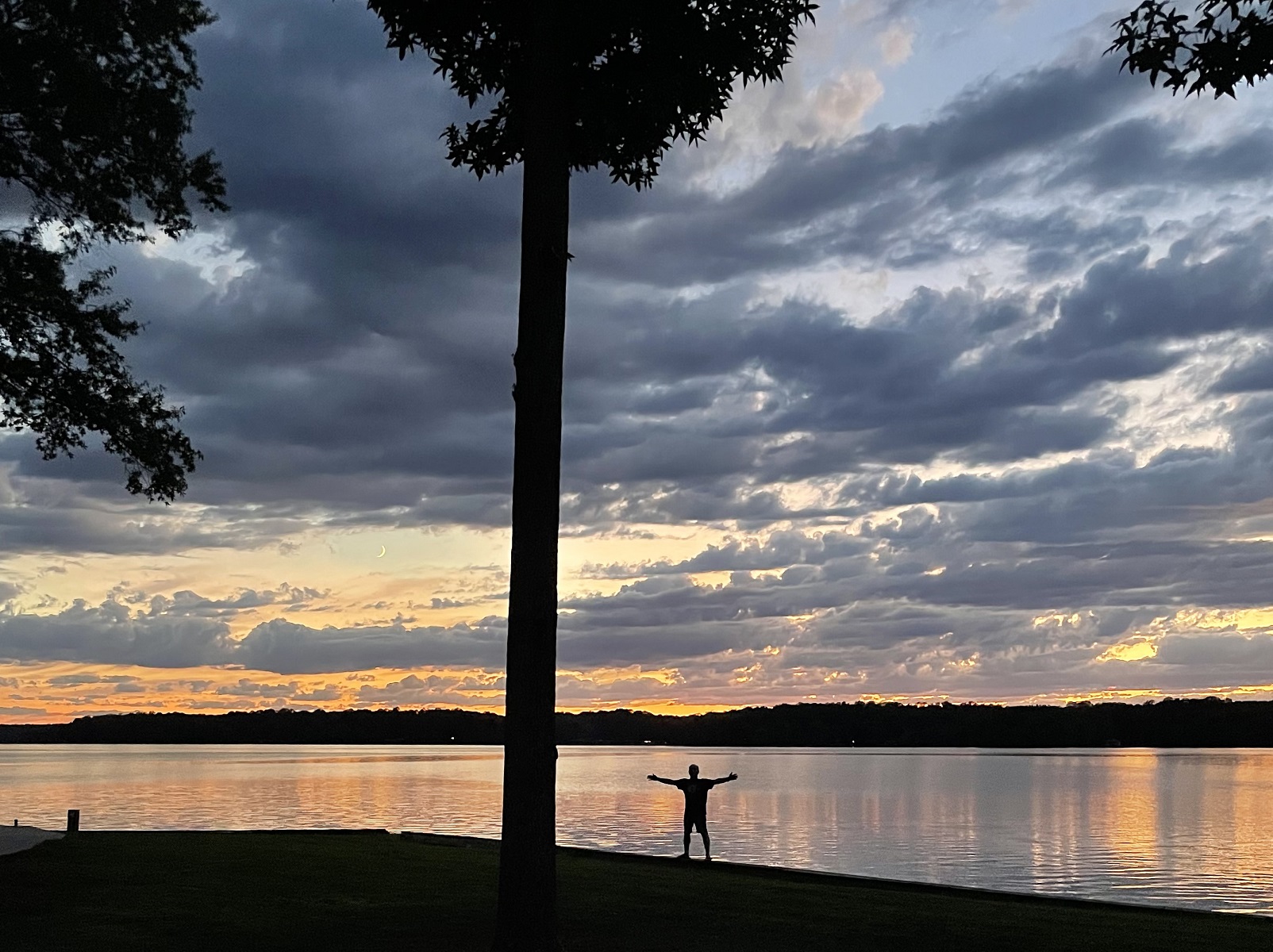
The first slide in my presentation was the image at the top of this post. This is a picture my son took of me on the evening of 8/25/25 on the shore of Lake Anna at sunset. The view was particularly beautiful that evening and if you look closely, you can see the crescent moon that was setting behind the sun. As another person in our group moved closer to the water to get a different view I noticed his silhouette so I quickly gave my phone to my son and asked him to take a picture of me as I struck a pose at the water’s edge. Looking at this picture now I see myself in a posture of gratitude.
10 minutes of my presentation was showing this video, a Ted Talk from 14 years ago by Louie Schwartzberg on gratitude. It is filled with beautiful time lapse photography and is narrated by Brother David Steindl Rast. Here’s a quote from Louie – “Gratitude unlocks the beauty of life. It turns what we have into enough.” and here’s a quote from David – “It’s not happiness that makes us grateful, it’s gratefulness that makes us happy.”
I also took a few minutes to point out the connection between remembering and gratitude. At some point in your life, someone taught you the spiritual disciplines that you practice today. That person may have been a leader, a friend, a grandmother, a pastor, or someone who is no longer with us. We should never forget them and the influence they’ve had on us. In the midst of the pace of work, errands, new friendships, and personal challenges, it can be easy to forget our roots.
Remembering is a form of humility and gratitude. We honor the efforts of those who have invested in our lives when we live with purpose, when we seek to grow, when we share what we learned. Today, think about the person or persons who left an imprint on your spirit. Perhaps it is time to write to them, to pray for them, or simply to give thanks in silence. Their influence is still alive in you, and now you can be that voice for someone else.
P.S. World Gratitude Day will be celebrated on Sunday, 9/21/25
This blog post is the expressed opinion of its writer and does not necessarily reflect the views of Tysons Interfaith or its members.
Contributed by Stephen Wickman, St. Thomas Episcopal, McLean
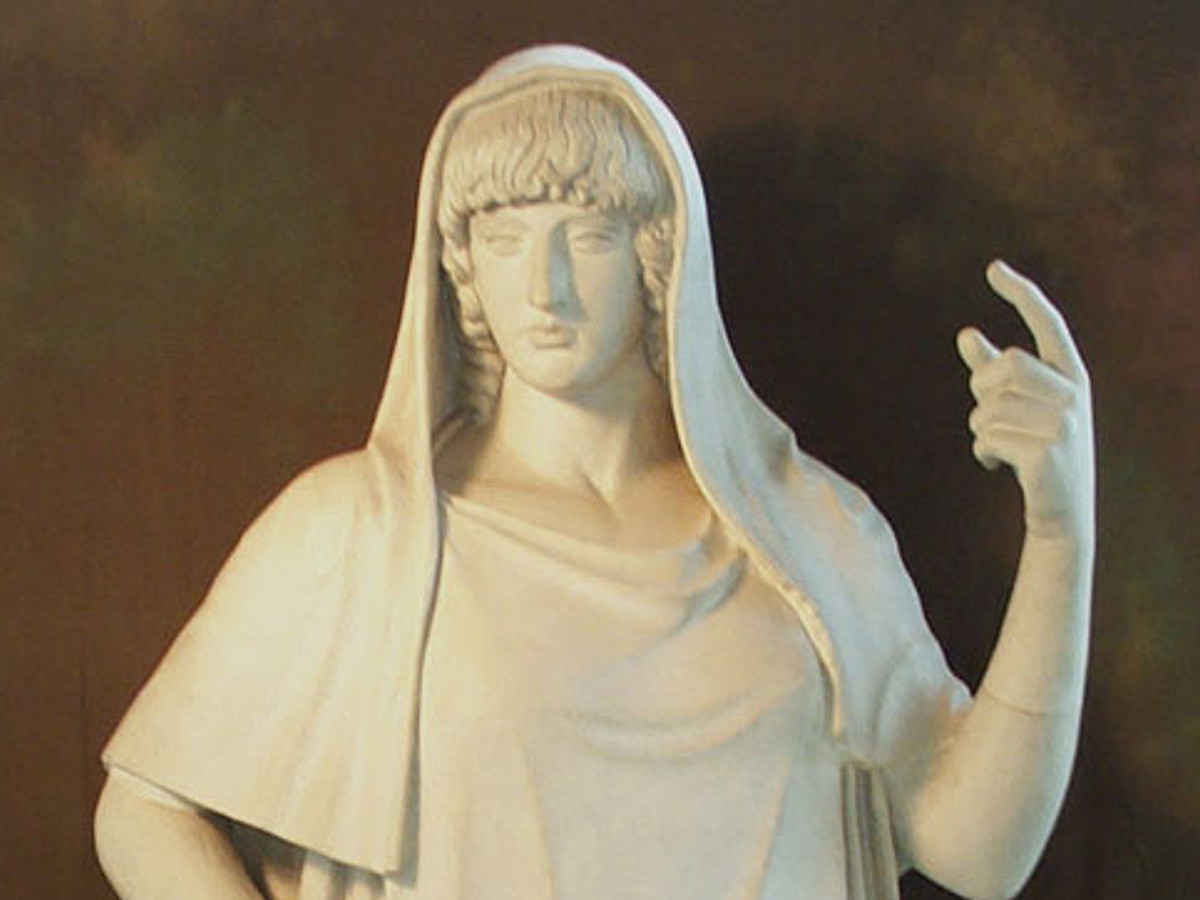
I had forgotten all about the book I had to read in high school until I heard this show about the Greek goddess Hestia (Vesta to the Romans). (BBC Audio | Natalie Haynes Stands Up for the Classics | Hestia That book is long gone, but my memory synchs nicely with the classicist podcasters message: she was the most important deity in classical Greek society – so fundamentally known to everyone that she hardly ever gets talked about in literature (you know, Homer and all those guys).
Hestia’s story is “juicy,” not because she flaunted her obvious physical attractiveness but because she spurned romantic approaches from her more well-known brother, Poseidon and her nephew, Apollo, vowing to Zeus that she would not take a partner. She also stood up to other women, like Aphrodite, who Homer tells us had no power over Hestia.
Hestia is identified with fire and the hearth and the abstractions of community and domesticity, not the fire of metalworking or war. Every Greek city had a communal hearth where her fire was set and worshiped. In art, she is often depicted simply and modestly in a veil or holding a staff or by a large fire, or sitting on a plain wooden throne.
The Christian tradition brings the Greek gods down to earth in the form of saints or maybe angels, and the one that Hestia reminds me of is Martha, who busied herself about the kitchen (the hearth) and complained that her sister Mary was doing nothing, just sitting and listening to the words of Jesus. And she appears in the Gospel of John as the sister of Lazarus. “There they made him a supper; and Martha served.”
Hestia, a bit like Martha, is the patron saint of those who focus on community and domesticity, two bookends that are closely related. If we love and tend to the needs of our own family that will lead to love and service to the greater community, a value that all our faith traditions share.
This blog post is the expressed opinion of its writer and does not necessarily reflect the views of Tysons Interfaith or its members.

Contributed by Stephen Wickman, St. Thomas Episcopal, McLean
This Sunday morning while walking my son’s ever-curious dog along the well-lit, beautifully engineered Vesper St. trail, which connects Route 7 and the toney suburbs of Vienna, I was not surprised to see an “unhoused” man, who quickly turned off his flashlight as we ambled past the path that enters the Tysons Forest to the east. Frankly, though I had seen unhoused individuals in Tysons, principally around the entrances to our new Silver Line Metro stops, I was somewhat astonished that no one had found the beautiful natural areas of our neighborhood.
After walking around almost every part of the Tysons area, with and without the dog, I could draw a map of areas that are amenable to hosting the unhoused, particularly when the weather is warm. I do not know if this individual was pushed out of Washington, D.C. by the National Guard and federalized police now clearing the encampments downtown (I was not going to interview him, especially since he discreetly turned off his light).
The irony is that this man was camped out in the shadow of the Amazon-financed affordable housing high rise, a stone’s throw from the Porsche and Land Rover dealership, and in sniffing distance of my 20-dollar cigar. The new housing complex, while commendable, will never accommodate this individual, who I dare conjecture brings in nothing like the 60% of “average median income” needed to qualify for the new apartments.
Also of note, the Tysons Forest has been home to the unhoused since the Paleolithic Era. During a cleanup of this beautiful watershed, a Park Authority expert showed us where he had found the makings of flints by human beings who lived here long before the Native Americans, White Europeans and freed slaves inhabited it. Yes, Tysons as you will see in an earlier blog post, was home to a community of freed slaves – notably Alfred Odrick, whose White Virginian master freed him after purchasing him and bringing him here from Haiti. ( Odricks Corner, Virginia – Wikipedia)
We at Tysons Interfaith are working with the Tysons Community Alliance (TCA) and the county to find a site for a meditation garden, most likely in the Tysons Forest. It would be fitting to honor Odrick and his predecessors with a sign or some sculpture. It would be even better if we could find a way to house this newcomer.
This blog post is the expressed opinion of its writer and does not necessarily reflect the views of Tysons Interfaith or its members.

Contributed by Andra Baylus, Regional Director of the Meher Baba Spiritual Community
Carrying out protecting citizens and the many variations of being a citizen, which includes people of different faith traditions, cultures, the wealthy, the poor, the middle class, the homeless and the immigrants, should be done carefully and respectfully taking into consideration each individual’s circumstances, thus ~ judiciously.
This is what America is all about.
When issues are raised of crime being rampant in DC and people not feeling safe to attend their houses of worship at night or people “disappearing” who are citizens and have not committed any crime, then of course, it is an invitation for action of some kind to take place to remedy these valid concerns. The questions then would be, “What kind of action is needed?” and, “How best can these actions be fairly implemented?”.
Not to act would be an abdication of governmental responsibility to protect its citizens, however, rounding up people indiscriminately may not be the wisest way to go about protecting the citizens of DC.
Muhammad (May blessings and peace be upon him- bpbuh) often spoke about the ” middle path”. He also was thought to have said that, “One hour of reflection is worth 70 years of prayer.”.
Would it be possible to follow the ” middle path” suggested by Muhammad (bpbuh) and pause to reflect upon how best to proceed?
Speaking to people who have experience in these areas of concern to seek their guidance would tap their knowledge and experience and help guide and refine actions to be not only fair to all citizens, but also effective. The importance and value of knowledge is firmly rooted in Islamic teachings. There are authentic Hadith that emphasize the obligation of seeking knowledge, such as: ” Seeking knowledge is obligatory upon every Muslim.”
“Seek knowledge even if you have to go as far as China” is a widely known saying attributed to the Prophet Muhammad (bpbuh), however, its authenticity as a hadith is debated among scholars. Many Muslims interpret this as a figurative expression emphasizing the importance of seeking knowledge diligently even if it requires traveling to the ends of the Earth.
Why not then seek advice about the issues of crime from professionals and before stepping forward to do something, is it possible to pause, do “due diligence”, inquire, reflect and use discernment to gauge the proper course of action.
All of our many faith traditions have wisdom embedded in our respective holy books and writings, as referenced above regarding Islamic texts. In today’s world, surely this guidance is more important than ever before.
This blog post is the expressed opinion of its writer and does not necessarily reflect the views of Tysons Interfaith or its members.
Contributed by Stephen Wickman, St. Thomas Episcopal, McLean
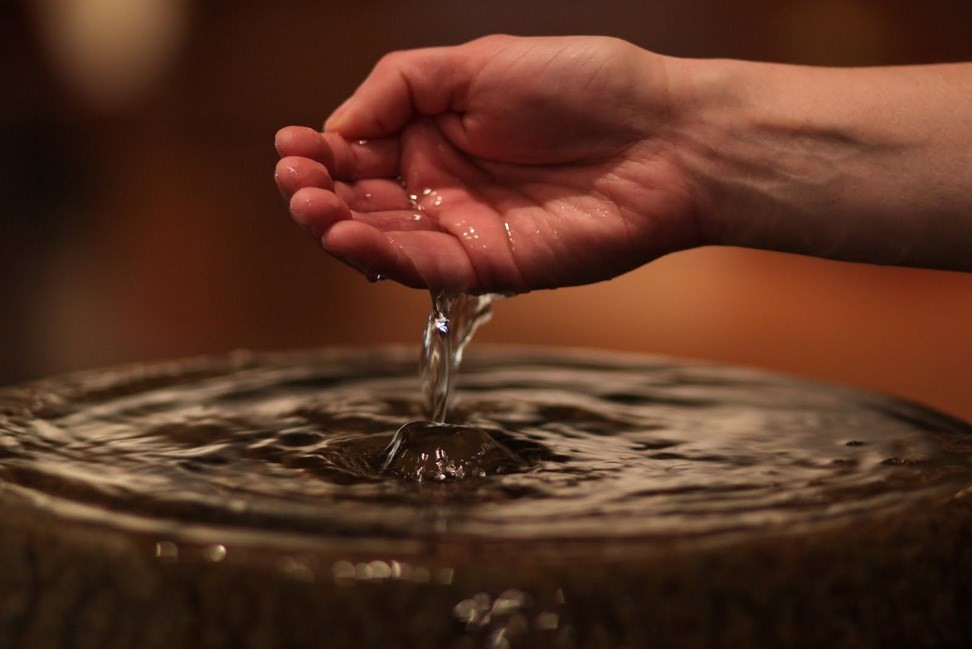
There is an ongoing debate in the Christian community about the “sacraments,” or what is essentially necessary to be a Christian. All of our communities agree on two: Communion (Eucharist, the Great Thanksgiving, the Mass) and Holy Baptism. Some traditions (primarily the Roman Catholic) claim you must be baptized in order to partake of the former. My church practices an “open table” theology, which is discouraged by some Episcopal Bishops. In short, the “open table” approach allows anyone to join in the Communion.
This is a sensitive matter for me, since I was “conditionally” baptized on August 19. You see, near the end of her life, my mother admitted to me that I may not have been properly baptized in the Pilgrim Holiness (now Wesleyan) tradition since they frowned on infant baptism. This was startling news because I was confirmed as a Methodist and then an Episcopalian on the basis on what I thought had been my infant baptism. But my mother said I may have just been “dedicated, not baptized.
If you believe all this mumbo jumbo, it’s a big deal. Hence my last-minute conditional baptism, which neither of my parish priests had ever administered. The only difference, is when the priest lays on hands he/she says “if you have not been baptized, then” etc.
It was an emotional moment for me. Adults are very different from infants. They can consider the surroundings, the few parishioners who joined a Tuesday noon mass at my church, the candles, the liturgy, the water on one’s head, the scent of the chrism applied to the forehead.
My rector, the Rev. Fran Gardner-Smith crooked her arm in mine as she presented me to our Assistant Rector. I was very moved. After all, I had served on the vestries of two Episcopal churches and I’m a certified lay Eucharistic minister.
But now I am “properly” baptized. This coming Sunday, we will baptize several Iranian converts. As I recite the baptismal vows, I will rededicate myself to some of the most extraordinary promises that any human can utter. If you are interested, please read What We Believe As Episcopalians, Starting With The Baptismal Covenant
This blog post is the expressed opinion of its writer and does not necessarily reflect the views of Tysons Interfaith or its members.

Contributed by Rev. Dr. Trish Hall
We have, in plain sight, an opportunity to create a world that works – a world that supports itself by connecting and nurturing all aspects of creation. The common phrase “hidden in plain sight” applies to much of our human experience. Life in all its messy diversity is blatantly in front of and all around us. We are immersed in it. We can pretend that it is not, and such pretense will only cause greater and greater rifts.
The idiom “hidden in plain sight” used by Edgar Allen Poe in his short story, “The Purloined Letter,” demonstrates the limits of human perception and the importance of observation, suggesting that something can be both conspicuous and inconspicuous at the same time.
Buddhism addresses the concept of “hidden in plain sight” by suggesting that the path to awakening is not about seeking something external or extraordinary, but about recognizing the truth that is already present in our experience.
Christianity guides followers to see the “hidden things of God” that are hidden in plain sight for those who have opened their eyes to see and their ears to listen.
Similarly, we often miss opportunities, such as the possibility of changing the whole world, because we go through life so preoccupied with routine activities. We miss the richness that is constantly presented to us. The admonition, “slow down and smell the roses,” advises us to take respites from our busyness to appreciate what is right in front of us.
Within current times that are often described as “tumultuous,” some of us withdraw into our personal cocoons, isolating from others, resulting in loneliness. Alternatively, we join communities with which we have a lot in common, and which exclude people unlike ourselves. To insulate from perceived dangers, these groups can take on the nature of gangs clustering together against assumed enemies.
With either approach, barriers emerge that block our ability to connect with the richness of Creation. The sense of separation – separateness –arises as fear and loneliness. Loneliness has been labeled a pervasive epidemic. Whether individuals isolate or withdraw into the assumed safety of cultural/community bounds, a shared fixation on contrast and differences, causes “othering.” Hostility and aggression ensue, and the chasms between peoples grow.
The opportunity presenting itself “in plain sight” is to become cultural connectors – bridge builders.
Creation is immeasurably diverse. Whether you count insects, reptiles, birds or mammals including humans there are myriad individuations – each unique – each one-of-a-kind! When we hide among those with whom we have an affinity, a resemblance or cultural connection, we rob ourselves of the opportunity to experience the richness of the creation.
Cultural blindness refers to the lack of awareness and understanding of cultural differences, often leading to the imposition of one’s own cultural values on others. It’s a state of being unaware of, or actively ignoring, the diverse cultural backgrounds, beliefs, and practices present within a group or society.
The practices of ignoring and/or othering are, unfortunately, exceedingly common. If we ignore those who are different from us, not only are we denying them recognition, we deprive ourselves of opportunities to learn and connect. If we engage in othering – labeling – we are judging, devaluing and relegating them to something unacceptable. We are separating them from us. We are denigrating and discarding them. Who are we to judge others based on our assumptions?
Whether you consider yourself a humanist, deeply religious or somewhere in the middle, it makes sense to interact with everyone and everything for the betterment of all. Inclinations to divide stem from fear based on biases, preconceived notions, or a lack of critical thinking.
I am inviting you to consider enhancing how you see the world. Even if you already embrace the concept of oneness (not to be confused with “sameness”), hidden biases probably are lurking within you. The way we humans learn is to observe, compare and store all our experiences. The moment we compare we are filtering our observations. That filtering function is the imposition of unconscious biases. Unless such biases are addressed at the conscious level, they alter perceptions like bugs in software that can cripple our operating systems. Although people often assert, “I’m not biased,” their internal controller adds: “provided people live their lives within my comfort zone.”
Does your heart yearn for a world composed of individuals, families, neighborhoods, cultures and communities living together in peace? Mine does. John Lennon’s song, “Imagine,” immediately comes to mind.
Wayne Dyer taught, “When we change the way we look at things, the things we look at change.” Life is composed of myriad cultures so cultural differences are ubiquitous. You may encounter communication disconnects within your own family, neighbors, religions, partisan perspectives, ethnicities or internationally. It’s important to acknowledge that gaps exist everywhere and all too often within our closest relationships. Many disconnects have taken on proportions that seem wider than the Great Rift Valley in Kenya.
When we shift how we see our world, we shift the world – we radically change relationships: interpersonal, interfaith, intercultural and international.
A Colleague stated, “How you see them is how you serve them.” How we see each person in our lives impacts how we relate to/with them!!
The opportunity to change the whole world by shifting how we relate to our fellow humans and all creation, is right in front of us, in plain sight.
Cultural diversity abounds around us. We get to be trail blazers changing the world by starting conversations even when we feel scared and especially when we feel unsure about whether our presence will be welcomed. Actually, our internal dialogue is a bold indicator that a situation is the perfect one to enter.
To foster and strengthen healthy intercultural connections requires that we step out of our own comfort zone to offer new ways of connecting. Such an approach requires sensitivity to bridge the gaps.
It doesn’t matter what your color, geography, ethnicity, nationality, gender identity, age, station, economic/community, or any other way in which you identify yourself, everyone is different!
Bridging such divides requires that we enter our pursuit with compassion, gently gleaning a sense of how it is to be someone. The task is huge and complex.
It requires commitment, determination, kindness and compassionate perseverance. The process requires delicacy and loving boldness.
The components are surprisingly simple. The application of those components can be challenging. The arena in which we need to apply those components is fragile. The essential element is trust undergirded by Love. Trying to reassemble trust, if broken, is much like trying to put Humpty-Dumpty together again, so let’s avoid breaking trust.
To build a bridge, we must assess the current situation:
- What are we moving from? Feeling discontent
- What are we spanning? Perceived differences/separation
- What is our desired outcome? Supportive interconnection
Peace and equity will only come to pass when we learn from and with people of other perspectives.
Together, we get to be bridge builders – to be initiators. Now is the perfect time to establish new patterns and new ways of relating – to embrace oneness boldly so that an observer would never doubt our belief in it nor our commitment to create a world that works for all.
Like love, our embrace of oneness cannot be conditional. It cannot depend on our comfort. Knowing that, as cultural connectors, we are facilitating the emergence of a world that works – a world that supports itself by connecting and nurturing all aspects of creation.
Engage in “witness consciousness” – observe yourself and others without forming opinions and jumping to conclusions. Not easy yet incredibly rewarding!
Embrace “beginner mind” and open to how it is to be someone of another culture or perception. Be flexible and adaptable. Identify shared values and common concerns. Open to possibility.
Encourage others to join you by creating a tsunami of connections. Barge out of your comfort zone. Accept that any stories you are carrying about other cultures are rooted beneath your conscious awareness, so you need to consciously release the hold they may have on you.
Now is the perfect time to embrace that YOU are a Cultural Connector – a transformative force in the universe creating a world that works for all.
This blog post is the expressed opinion of its writer and does not necessarily reflect the views of Tysons Interfaith or its members.